Feature
Progressive Overload Tracking
Progressive overload is the foundation of strength training: gradually increasing the demand on your muscles over time. Plates tracks this automatically and tells you when you might consider adding weight and by how much, and why.
How it decides you're ready
The suggestion engine looks at your recent sessions per exercise, not a simple "hit 3x8, add weight" rule. It reads the full picture:
Track reps + RPE
Log your working sets normally
Learn your profile
Pro tunes your grind threshold
Estimate readiness
Stable effort + consistent reps
Suggest increase
Equipment-aware weight jump
Nine suggestion types
Progressive overload is just one signal. The engine generates nine distinct recommendation types based on your data:
| Suggestion | What it means | When it triggers |
|---|---|---|
| Weight increase | Consider a load increase | Hitting your rep target at a stable, controlled effort |
| Rep increase | Add reps before weight | Below rep target but effort is low |
| Deload | Time to recover | Estimated 1RM slipping against your personal threshold |
| Fatigue warning | Back off slightly | RPE rising without load change |
| Plateau detection | Stuck at the same weight and reps | No progress across several sessions at stable effort |
| Hidden progress | e1RM climbing quietly | Gaining strength you can't see in raw numbers |
| Too light | RPE consistently low | Effort sitting below your target zone |
| Volume hold | Stay steady | Recent increase, need to consolidate |
| E1RM gain | Estimated max improved | Significant jump in calculated strength |
Real scenarios
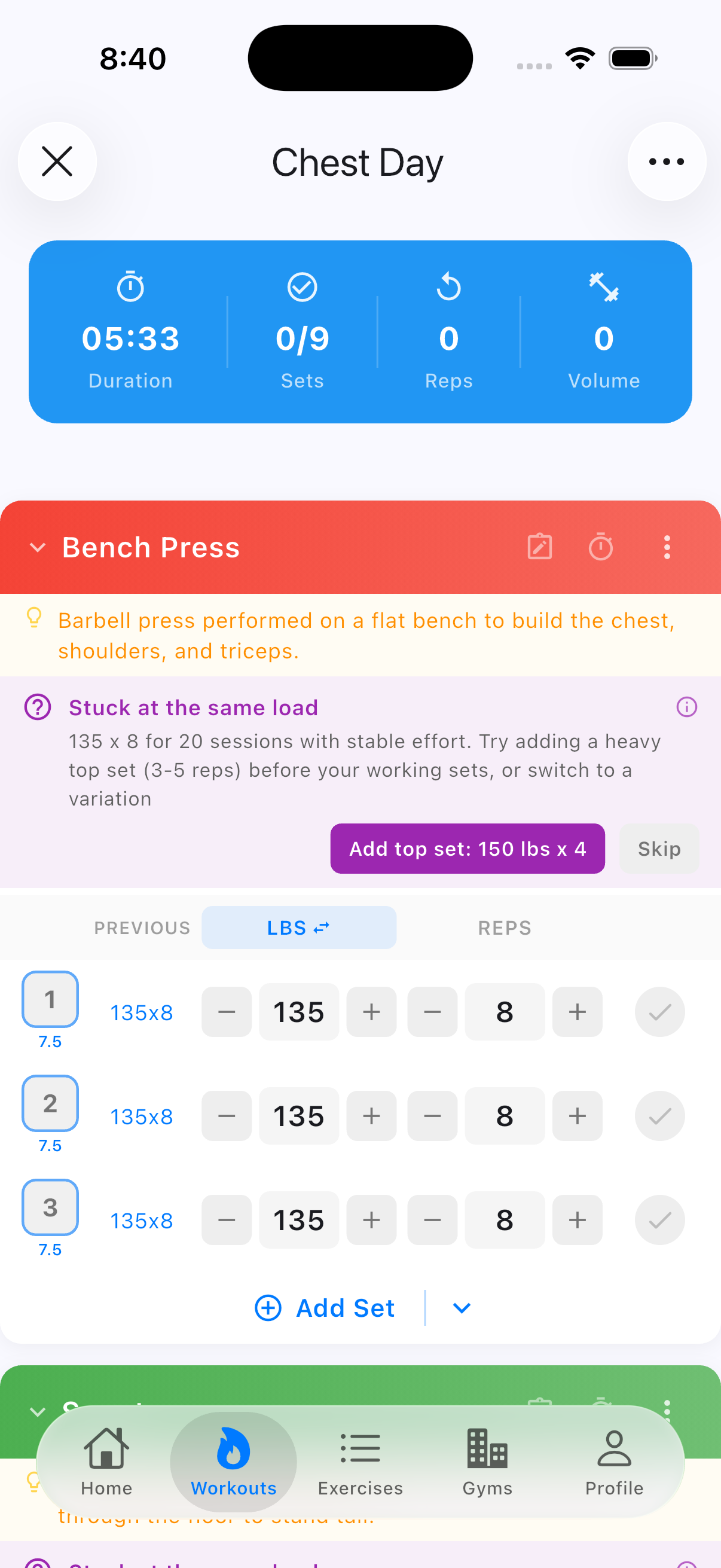
Plateau detected
Bench Press: 135 lb x 8 for several sessions at stable effort
You've hit 3 sets of 8 at RPE 7.5 session after session with nothing moving. The engine flags this as a plateau and suggests adding a heavier top set (150 lb x 4) before your working sets to break through.
Hidden progress
Squat: same weight, but 1RM estimate up 8% over 6 weeks
Your working weight hasn't changed, but your rep quality improved: more reps at the same RPE. Your estimated 1RM is climbing even though you can't see it in the raw log. Plates catches this.
Context-aware hold
Mid-cut: suppressing progression to protect muscle
You're in a calorie deficit. The engine knows your diet phase and holds back weight-increase suggestions. Maintaining load during a cut is the real win, and Plates tells you that.
Equipment-aware weight jumps
Plates rounds load suggestions using your configured equipment. It uses sensible increments for the equipment type, smaller steps for dumbbells and isolation work, larger steps for barbells and machines, to help propose practical increments. Equipment settings and suggestions still need your review.
It uses your gym's configured plate inventory when calculating loads. Check your actual plates, bar weight, equipment, and units before lifting.
Context-aware intelligence
Every suggestion adjusts based on your current state:
- Diet phase: more conservative during a cut, more aggressive during a bulk
- Program phase: suppresses progression during deload/test weeks
- Session readiness: suppresses all progression on a rough day
- Training history depth: waits until it has seen enough of an exercise before suggesting anything
On-device, always private
All analysis runs locally on your phone. Your training data never leaves your device for suggestion computation. No cloud machine learning, no data harvesting, no internet connection required for suggestions to work.
What's free and what's Pro
The full suggestion engine, all nine types, weight-increase and deload suggestions included, is free. Every lifter gets the same coaching out of the box, using default training thresholds.
Pro adds the personalization layer on top:
- Adaptive Learning: on-device machine learning learns your recorded effort patterns, progression rate, and fatigue indicators, then tunes every suggestion to you. The Progress hub's Adaptive tab shows the learned values and a "see the math" breakdown.
- Per-exercise progression schemes: pin how each lift progresses (reps then weight, add weight each session, match a target effort with RPE autoregulation, or hold). Free users get the automatic default; the training-goal rep-range pin stays free.
Use your judgment: Plates provides automated fitness estimates, not medical advice or confirmation that a load, program, or target is safe for you. Review suggestions, adjust or skip them when needed, and seek qualified advice for your circumstances. Read the fitness guidance and exercise-risk terms.
Try Plates free
Workout logging and the full suggestion engine are free, with no time limit. Adaptive Learning and progression schemes are part of Plates Pro: $2.99/month or $23.99/year, with a 14-day free trial.